A SHORT ACCOUNT OF THE POBŁOCKI FAMILY
I. In 1797 Wojciech (Albert) Delk Pobłocki bought a farm in Linia. He married a Zielezińska, and after her death he married Milczewska, his servant, who played the great lady, squandered the farm, and even had an ox unhitched from the yoke when she had a craving for beef. Delk is a byname of one branch of the Pobłockis of Pobłocie. By the late 18th century that blood was leaving the village: in the 1772–1773 tax cadastre it appears there only through daughters.
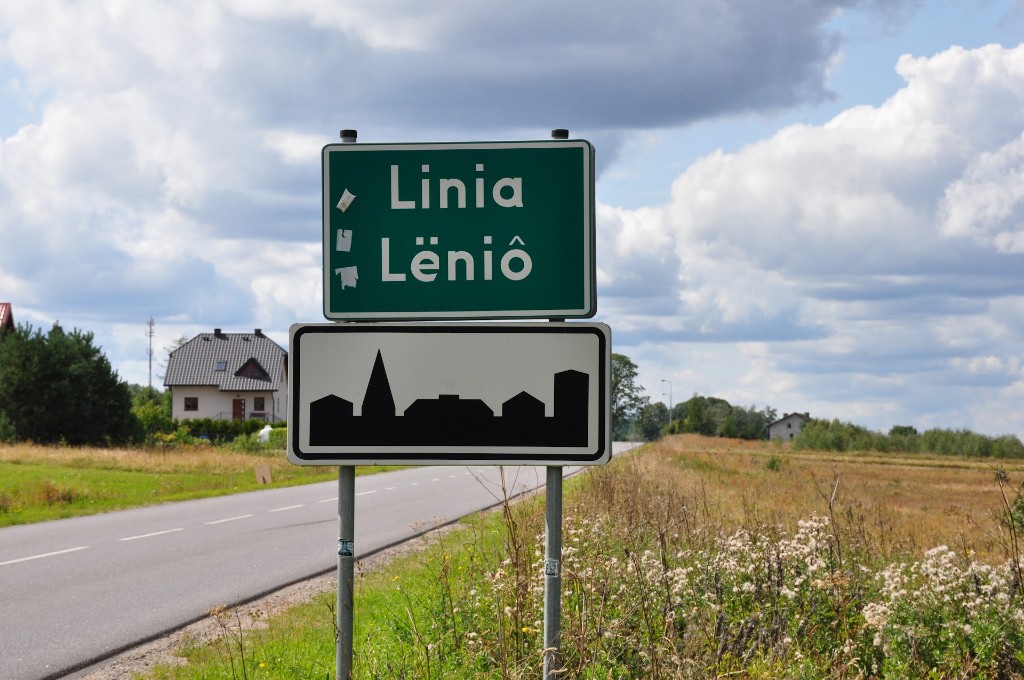
II. Augustyn was married to Joanna Ernestyna Sychowska. She was a very capable manager and ran the farm in Linia with a sure hand, while her husband was a teacher in Łężyce, near Rumia. The sons’ birthplaces follow those two homes: Juliusz was born in Łężyce, Leon in Linia. They raised 5 sons, 4 of them priests, and 2 daughters. A plaque dedicated to the Pobłocki priests hangs in the vestibule at the entrance to the church in Linia.
- Albert (Wojciech), *1853-10-06 in Linia, †1923-10-17. He studied at the gymnasiums in Wejherowo and Chełmno, read theology in Münster and Innsbruck, was ordained in 1878, and took his doctorate in Rome in 1881. Until 1886 he was curate to his brother Juliusz in Chełmno, then administrator in Wabcz, and from 1896 parish priest in Niedźwiedź. In 1899 he founded the Towarzystwo Wiecowe in Chełmno and published Bishop Andrzej Leszczyński’s 1647 visitation of the Chełmno diocese.
- Gustaw, 1840-09-21 in Łężyce, †1915-11-25 in Wtelno, a doctor of divinity, lexicographer, and writer. He was parish priest of St Barbara in Kokoszkowy, between Fr Karol Latzke (until 1889) and Fr Wawrzyniec Insbrandt (from 1905). That is Kokoszkowy near Starogard, not Kokoszki in today’s Gdańsk. From 1905 he was parish priest in Wtelno, near Bydgoszcz, and he died there. He published *Słowniczek kaszubski (Poznań, 1875) and Słownik kaszubski z dodatkiem idyotyzmów chełmińskich i kociewskich (Chełmno, 1887).
- Leon, *1856-09-11 in Linia, †1900-11-11 in Chełmno, where he is buried. A historian, teacher, and missionary. He was a Resurrectionist, went from Rome on a mission to Adrianople, and after an illness joined the Lazarists in Kraków.
- Juliusz, *1835-11-29 in Łężyce near Rumia, †1915-02-09 in Chełmno. A doctor of divinity, dean of Chełmno from 1888, honorary canon from 1904, and parish priest of Chełmno from 1872 to 1915, and a teacher and social activist. He studied theology in Pelplin and in Münster. He wrote the memoir Na Kaszubach przed stu laty.
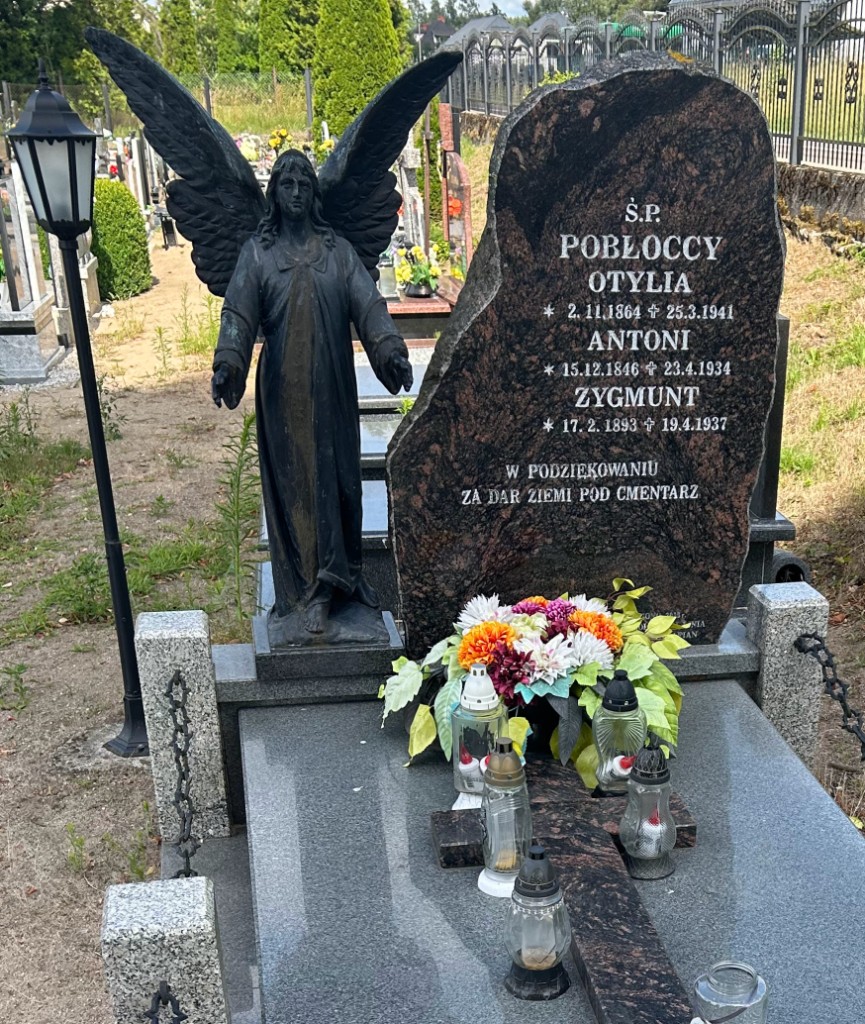
- Antoni, *1846-12-15, †1934-04-04, owner of Linia. He is buried in the parish cemetery at Linia.
- Emilia married a Czarnowski and died on †1907-10-30. Their son was Tadeusz Czarnowski, director of the Regional Directorate of the State Railways in Gdańsk until 1939, with a private saloon car.
- Matylda, born in September 1840, married Jan Prabucki, owner of Grabowiec in the parish of Bobowo, and is buried in the old cholera cemetery at Bobowo. Their son Władysław (1885-09-08 in Grabowiec, †1954-05-17, buried in Jawor) took over Nowa Wieś in Golub county. Jan bought it on 14 November 1889 and transferred it to his son on 23 March 1908. Around 1910 Władysław married Wanda Żelewska (1884, †1935). Wanda was the sister of Aniela, wife of Jan Woyke, owner of Łężyce, and their daughter was Zofia née Woyke, wife of Zygmunt Pobłocki. Władysław and Wanda’s son Witold (*1913 in Nowa Wieś, †1981) continued that line.
In the cemetery at Chełmno, in the first row from the top, is the grave of the Pobłocki family:
- Rev. Dr Juliusz Pobłocki, *1835-11-29 †1915-02-08, dean and parish priest of Chełmno,
- Antoni’s father, Augustyn, *1808-08-25 †1886-05-17,
- Antoni’s mother, Ernestyna née Sychowska, *1815-08-14 †1900-05-17,
- Antoni’s brother, Rev. Leon Pobłocki, a monk, *1856-09-12 †1900-11-14,
- Antoni’s sister, Emilia Czarnowska née Pobłocka, *1884-01-06 †1907-10-30,
- Emilia Czarnowska’s daughter Anna, *1870-05-04 †1983-06-03,
- and a second daughter, Maria, *1865-01-01 †1934-11-18.
III. Antoni and Otylia née Karszna, born in Potęgowo on *1864-11-02, died †1941-03-25. She was eighteen years younger than her husband and outlived their son Zygmunt: she died during the occupation. They raised 6 sons and 2 daughters.
- Władysław and his wife Kazimiera (no children). A philologist and surveyor. After many years of work in America he returned and lived in Wejherowo. From 1928 to 1939 he was editor of Gazeta Kaszubska. A city directory of about 1925 lists him as a journalist, at Hallera 5. In the same book Dr Juliusz is a judge at Dworcowa 2. Władysław joined the board of “Gazeta Kaszubska” Drukarnia i Wydawnictwo S.A. in Wejherowo, registered on 5 September 1922. The paper ran until 1939. At its founding the largest shareholder was Ignacy Żylicz, and the other named board member was Józef Kokornaczyk. He was also a sworn translator of English, French, German, Russian, and Latin. He lived and died in Wejherowo.
- Dr Juliusz Pobłocki, *1888, and his wife Helena, raised 2 daughters and a son. In 1939 he was vice-president of the regional court in Gdynia. From the company’s registration in 1922 he sat on its supervisory board. During hearings he spoke Kashubian, and in the courtroom he took snuff and offered it to others.
- Stanisław, *1890-02-14 in Linia, a doctor and a captain in the Polish Army. He died on †1942-01-11 as a prisoner of war, a physician in the camp hospital of Stalag XI C. He lies in an individual grave in the war cemetery at Bergen-Lohheide, beside the Bergen-Belsen camp, among the dead of a typhus epidemic. In 2012 a cross was set there with his name and that of Dr Roman Bilnik. His sons Zbigniew and Stanisław lived in Wejherowo after the war.
- Zygmunt, *1893-02-17, †1937-04-19. At the age of 44 he was killed in a car accident in Łężyce.
- Wojciech was killed on the German–French front in †1916, as a German soldier.
- Kazimierz, a second lieutenant of the Polish Army, fell †1920-08-15 near Warsaw.
- Jadwiga married a Szukalski, of the Lipinki estate, Starogard Gdański county. During the war she took part in the resistance in Pomerania. She died in Wejherowo.
- Apolonia married Andrzej Wawrzyniak in Brzusce, post office Subkowy.
IV. Zygmunt Pobłocki and Zofia née Woyke raised 3 sons and a daughter. Zygmunt was the wójt of Gmina Linia and a member of the county council in Wejherowo. In 1926, described as a farmer from Linia, he joined the county National Defense Committee. In 1930 he became president of the committee that founded the volunteer fire brigade in Linia. He was widely known and well liked.
He was buried beside his father Antoni and his mother Otylia in the parish cemetery in Linia. He himself had given the land for the cemetery. The stone thanks the family for that gift of land, and the parish-history board in the church at Linia records a donation by the parishioner Zygmunt Pobłocki, after which the parishioners fenced the cemetery.
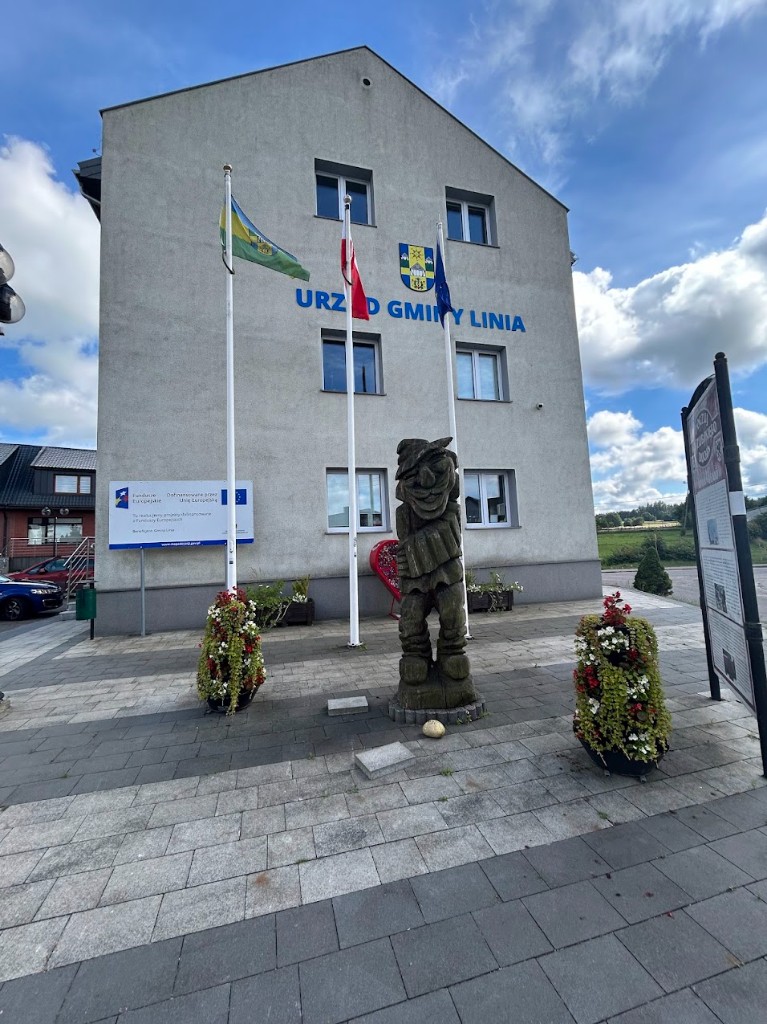
Zofia kept the farm books and served as the civil registrar. After her husband’s death she managed the farm with the help of a steward. After the occupation of Poland in 1939, Polish farms in annexed Pomerania were placed under compulsory administration. From 28 February 1940 that administration was the Ostdeutsche Landbewirtschaftungsgesellschaft, known as Ostland. In 1942 it was renamed the Reichsgesellschaft für Landbewirtschaftung, or Reichsland. Zofia and her family were turned out of the house, and their belongings were taken by the family of an SS man from Gdańsk who managed Polish farms. A shed on the estate was used during the war as a Gestapo lockup. It was demolished in 1975, when the volunteer fire brigade built its station. After the war, communist People’s Poland seized the farm again: the residence was converted into the municipal office, and the land was parceled out. The Pobłocki family had to leave the county and moved to Lower Silesia.
The Linia estate covered 252 ha, of which about 40 ha were woodland, with meadows and other land. Besides the house, the buildings were a stable, a cowshed, a pigsty, a granary, and a barn. The farm also included 3 two-family houses, with small barns and cowsheds, for the workers. There were also 3 tenant houses (so-called pustki), with their farm buildings, 3 km from the farm.
V. Zygmunt and Zofia née Woyke raised three sons and a daughter. Of the sons, Bogusław is known, and his younger brother Janusz.
Bogusław died in 2014. With his wife Zofia — a different Zofia from Zofia née Woyke — he lived in Szyszkowo, in Lower Silesia. They had four children, from oldest to youngest: Grzegorz, Michał, Cezary, and Anna.
Sources
- Juliusz, Gustaw, and Leon Pobłocki in M.J. Minakowska’s genealogy, after Polski Słownik Biograficzny, vol. 27. Their mother’s name: Leon’s source record.
- Władysław Prabucki, with the family chronicle.
- The Pobłocki arms, after Przemysław Pragert.
- The parish of St Barbara in Kokoszkowy.
- Gustaw Pobłocki’s Słownik kaszubski.
- Bergen-Lohheide, Porta Polonica.
- List of landed estates, Pomeranian voivodeship.
- The volunteer fire brigade in Linia.
- Ostdeutsche Landbewirtschaftungsgesellschaft.
- The manor at Pobłocie. The gravestone and the parish board at Linia are on this site.
- Józef Borzyszkowski’s sketch of Gustaw and Juliusz, in Zasłużeni ludzie Pomorza Nadwiślańskiego z okresu zaboru pruskiego, Gdańsk Scientific Society, Pomorze Gdańskie no. 12, Gdańsk 1979. The Münster academy registers were compiled by Fritz von Poblotzki, Münster 2003.